Services Dropdown
- Communications
- Electrical Construction
- Power Line
- Renewable Energy:
- Solar
- Wind
- Substation
- Technical Services
- Transportation:
- Airports
- Bridges
- Highways


Albany New York’s Empire State Plaza is a ninety-eight acre interconnected state governmental complex containing ten distinctive office buildings, including the marble-clad forty-four story Corning Tower, the tallest building in the state outside of New York City. The Plaza was constructed between 1960 and 1976 at a total cost of $1.7 billion. The Plaza is on the New York State Office of General Services’ (NYSOGS) short list for administering a $73.5 million capital program to upgrade and modernize electrical and mechanical systems at select state facilities across New York.
As part of the NYSOGS capital program, O’Connell was awarded a $1.3 million contract to perform upgrades and testing to Empire State Plaza’s main substation. O’Connell has been awarded several contracts under the OGS program.
The primary task for this project involved removal of the substation’s original transformer, installed 45 years earlier, and replacing it with a new 34.5kV unit. The project took on an added element of challenge with the substation vault located several stories underground within the Plaza. O’Connell employed the use of 600-ton crane to move and place each of the transformers.
O’Connell provided temporary power for the project and performed systems testing. The transformer switchout was scheduled over a weekend to help minimize impact on Plaza functionality as well as on busy Capital District traffic and was carried out in one day. Through efficient project management and oversight by O’Connell, the substation upgrades were seamless to the 13,000 state employees who work across the complex, to businesses operating within the Plaza’s Concourse, and to the public. In the face of numerous challenges encountered in a short project window, all work was performed effectively, efficiently, and without a safety incident.

New York State Office of General Services put out a bid notice for installation of a comprehensive audio and video monitoring system at Albion Correctional Facility in Upstate, New York. With a history dating back to 1892, Albion is a medium security women’s prison run by the New York State Department of Correctional Services—one of six female facilities in the State.
O’Connell has project experience at more than 65 correctional facilities and prisons across New York. We were awarded a $5 million contract to install the new audio and video monitoring system at Albion as general contractor for the project. Work involved construction and excavation between the primary control center and 24 other buildings being monitored. Included were installation of 400 color closed-circuit television cameras (CCTV) inside and out, 300 high-sensitivity boundary microphones that utilize walls for sound pick-up, and remote equipment racks at each of the 24 buildings. O’Connell also constructed the climate-regulated control room that features 21 seven-foot-high equipment cabinets for the head-end digital recording system, CCTV matrix switch, fiber optic interface equipment, and several interface consoles.
O’Connell needed to position, aim, and focus each CCTV camera precisely to achieve zero blind-spots and optimum clarity. The audio system required our professional expertise and fine-tuning to optimize microphone positioning as well as system component settings and sound level adjustments to capture the maximum range from each site. O’Connell installed all electrical and communications conduit, cable, and wire for the project, often cutting and drilling through concrete walls and foundations to gain access to a diverse collection of structures.
O’Connell’s experience working at prison facilities ensured that there were no security breaches during the project and no employee, inmate incidents. Our work was completed within the original 20-month time allotment with no safety related incidents.

State of New York, Office of General Services put out renovation bids for Building 41, Central New York Psychiatric Center. The building is a 210 bed maximum security facility constructed and operated by the New York State Department of Mental Health.
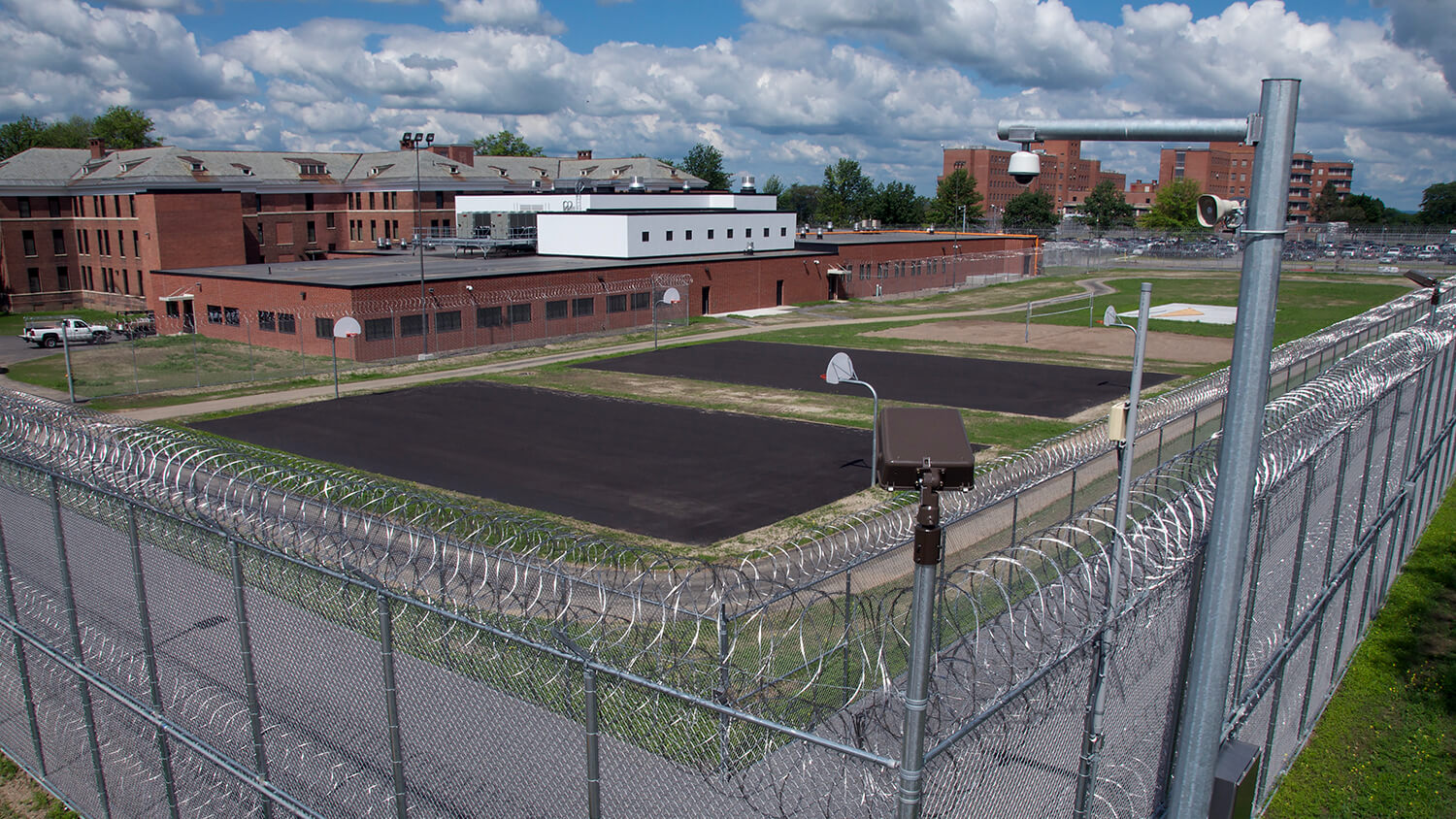
O’Connell Electric completed a $5 million contract to provide perimeter security systems and fencing for Building 41 as well as its security console and video recording equipment. Our electrical construction work included exterior security and sports field lighting, perimeter fence sensor cabling and microwave security system, fence personnel alarm and public address system, perimeter CCTV system, and gate control system. O’Connell was acting GC for the contract which also included site excavation, grading, new storm and sanitary sewers, a large retention pond, sidewalks, new recreational sports fields, new access roadways, and a double security fence to enclose the complex.

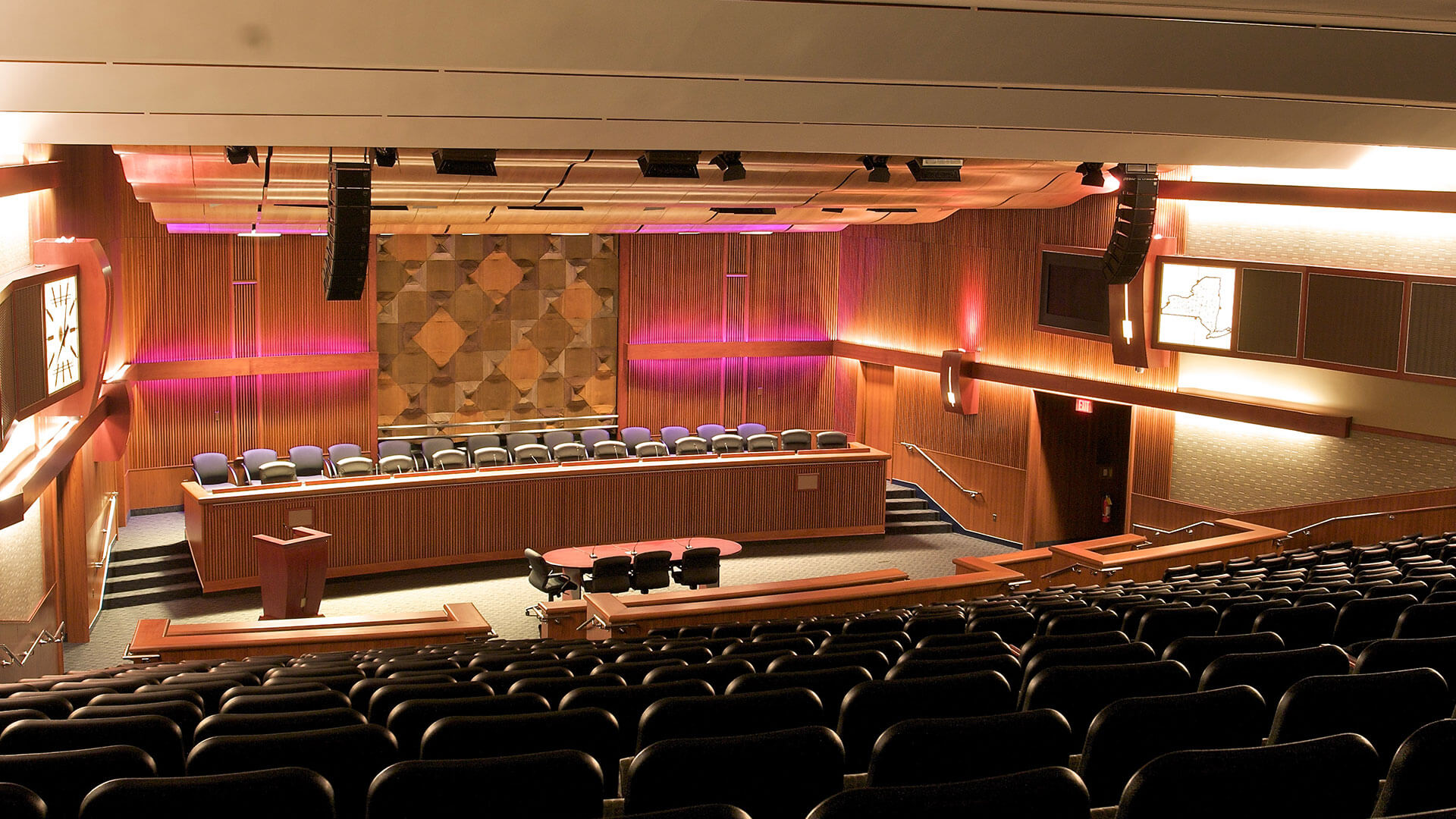
Albany’s New York State Legislative Hearing Rooms recently underwent $5.2 million in renovations and upgrades. Located at the north end of the Empire State Plaza in the Legislative Office Building, the three hearing rooms are in use nearly year-round by both the Senate and Assembly as well as other state agencies.
In an attempt by state government to become more visible and transparent to the average citizen, a key aspect of the renovations involved incorporating numerous technological upgrades and advancements. The new audiovisual systems allow for digital projection of material on large format monitors for the audience and legislators as well as for enhanced television and radio transmission.
Several aspects of the renovation project were driven by Federal and State mandates. The the Legislative Office Building was constructed in the early 1970s with the Hearing Rooms receiving their last major upgrade more than three decades ago. Seating capacity between the three hearing rooms totals nine hundred.
Under contracts totaling $2.5 million with New York State’s Office of General Services, O’Connell contributed both electrical construction and communications services to the renovation project. O’Connell upgraded existing electrical which involved new panels and an expanded power distribution system that included installation of conduit, wire, and receptacles as well as device terminations and a building card-access system that we integrated in conjunction with Honeywell. We installed all new general lighting as well as the specialty theatrical lighting systems necessary for televising in HD from the hearing rooms. Our Communications Division installed the new fiber optic backbone, with terminations and testing, including the raceways that support each of the three hearing rooms’ state-of-the-art, production-quality audiovisual systems and control rooms.
Throughout the duration of this two-year project, O’Connell maintained a clean safety record with no recordable injuries.

Under a $17 million grant from the FAA’s Airport Improvement Program, funding was made available for Greater Rochester International Airport (GRIA) to improve runway safety. The work involved construction of two new vehicle tunnels, addition and relocation of utilities and removal of obstructions on airport grounds to create a safety zone at the east end of runway 10/28.
On a $1.7 million subcontract from Crane-Hogan Structural Systems, O’Connell provided all electrical construction of underground conduit and cabling as well as light fixtures and controls required for the automated environmental lighting systems of the two vehicle tunnels. Fire alarm and security systems were also installed. The project spanned two years and was completed on schedule.

Established in 1934, the Buffalo Municipal Housing Authority (BMHA) is responsible for the construction, rehabilitation, and modernization of low-income public housing within the City of Buffalo as well as all management and operations. Today, nearly 12,000 residents live among BMHA’s 27 developments. To help combat crime the Buffalo Police Department has established a dedicated Housing Unit consisting of 21 police officers to patrol, police, and manage security issues across all complexes. In turn, BMHA has committed to increase security measures which includes substantial investments in state-of-the-art closed-circuit television (CCTV) video surveillance systems at each site that will eventually be tied together at one centralized location.
O’Connell was contracted by the Buffalo Municipal Housing Authority to install the first phase of CCTV cameras at five of their developments. Installations involved hardwiring the video cameras with low-voltage power taken directly from that building’s power supply panel. We mounted and positioned the cameras with line-of-site to a centralized antennae we installed on the property that transmits the video signals to a digital video recording system (DVR) for storage and retrieval. One site’s layout was not wireless-friendly and required fiber optics to carry the video. We installed all fiber optic cable, made the terminations, and performed testing on the system.
Angling the cameras and determining focus required precision. O’Connell worked closely with the project’s integrator, who specified the video hardware and engineered the system’s line-of-site positional planning, to achieve exactness. Each of the five installations were designed to function both independently or as part of a larger integrated system where all video can be reviewed and evaluated at a centralized location. O’Connell installed 80 cameras for this first phase of work.
With most work at the job sites having been accomplished at heights of two stories or more, requiring the continual use of extension ladders, small bucket trucks, and even a man-lift to install a 100 foot-high tower antennae, O’Connell exhibited exceptional safety performance with no reported safety incidents throughout the project.

As part of the region’s Western Gateway Initiative the City of Rochester, Monroe County, and New York State embarked on a $38 million bridge replacement project involving the heavily travelled Interstate 490/Rochester Innerloop corridor. The City of Rochester wanted a “signature bridge” to define the area’s redevelopment program for this high profile crossing of the Genesee River. To achieve this, a 433 foot steel cable arch bridge was designed to span the river rising 100 feet above the water. The bridge is one of the widest steel three-rib true arch bridges in the world (130 feet). Decorative lighting arrangements were designed to give the bridge added aesthetic appeal.
In 1972, O’Connell had provided electrical construction services on the former Troup-Howell Bridge for a major lane expansion initiative. Thirty-five years later we were back on location providing electrical construction services for lighting the new bridge. O’Connell aided field engineers in interpreting the electrical plans for the bridge’s innovative accent lighting system and worked closely with the general contractor and New York State DOT to satisfy all electrical objectives. The final results speak for themselves.

In conjunction with recent safety improvements, Greater Rochester International Airport completed an FAA runway upgrade project that involved installation of a new medium-intensity approach lighting system at the east end of runway 10/28.
On a 6 month, $900,000 contract with DME Corporation, O’Connell installed GRIA’s new approach lighting system. Our scope of work involved removal of several light towers and the existing control vault building, modifications to light towers, installation of five new light towers, new control vault building, new cabling and controls, new electrical service for the lighting system, and construction of new access roads. One challenging aspect of the project included 350 feet of directional drilling under a heavily travelled section of Interstate 390 and its off-ramps to facilitate power and controls to new light towers outside of airport property. As general contractor on the project, O’Connell provided project management as well as coordination between the FAA, GRIA operations and DME.