Services Dropdown
- Communications
- Electrical Construction
- Power Line
- Renewable Energy:
- Solar
- Wind
- Substation
- Technical Services
- Transportation:
- Airports
- Bridges
- Highways


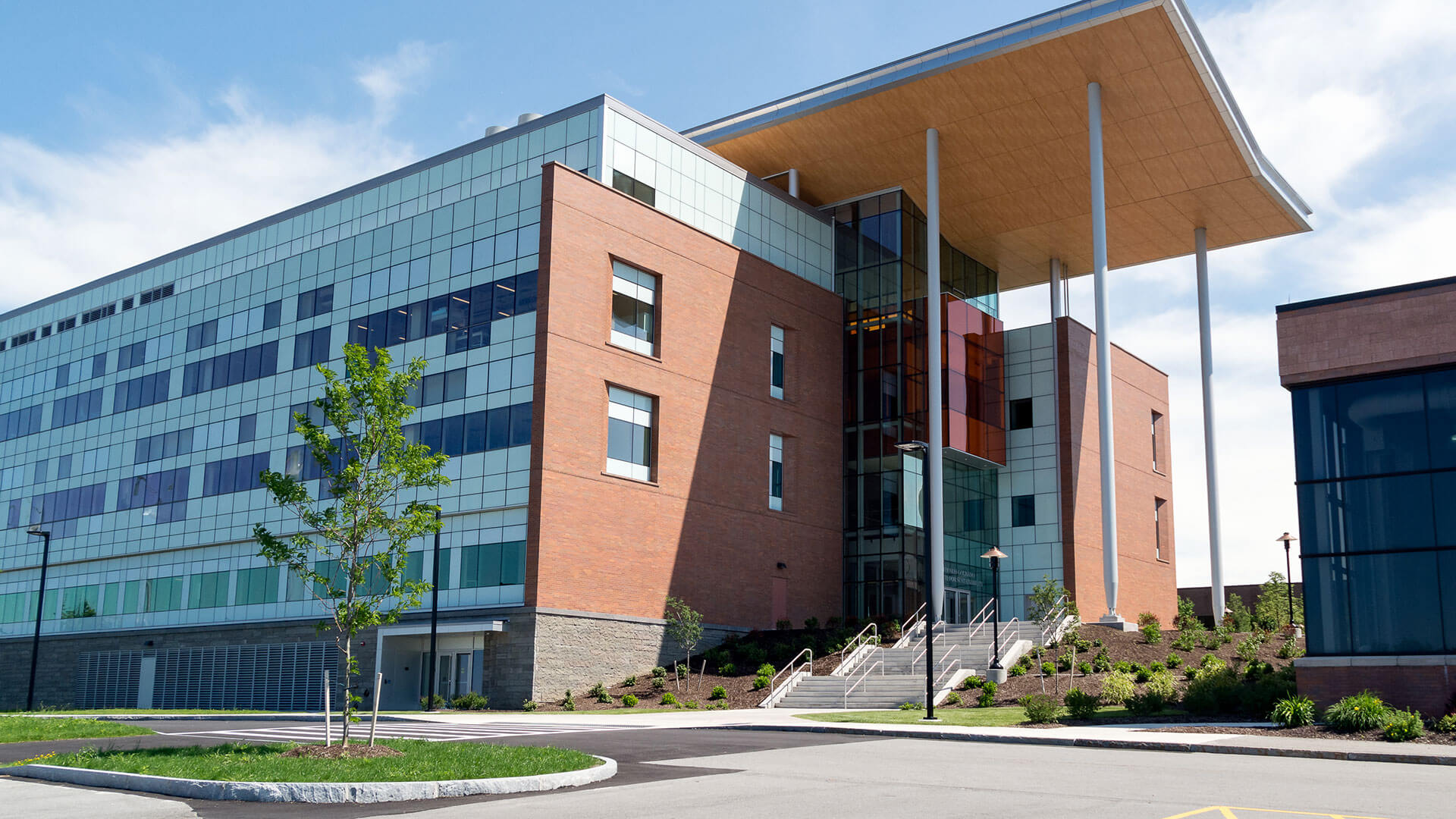
The 6 story, 235,000 square foot Syracuse University Life Sciences Building was the largest project undertaken in the university’s history at a cost of $110 million. The massive structure was integrated with the existing Center for Science and Technology Building via a four story glass atrium that joined them.
O’Connell subcontracted from Barr & Barr Contractors, completing $9 million of major electrical construction work. Electrifying the building included installation of all switchgear, conduit and wire, interior and site lighting, lecture room dimmer systems, and building lighting control system with integration to the campus-wide building management system. We provided power distribution throughout the building via two unit substations with 4.8KV primary 480V/277V secondary with main-tie-main busways. Two natural gas generators were installed on the top floor with control switchgear and automatic transfer switches for emergency power backup. O’Connell installed the lightning protection and grounding systems which required grounding wells in excess of 300 feet. We outfitted the complex with complete fire protection systems, voice and data raceways, and security conduit systems.
O’Connell was also awarded a $2.7 million contract to upgrade the university’s north campus high voltage substation upgrade portion of the project.

Rochester Institute of Technology’s College of Applied Science and Technology Building is the campus’s first green certified structure. At $10.6 million the contemporary 43,000 square foot facility was designed to meet LEED standards (Leadership in Energy and Environmental Design). CAST was awarded Gold Certification by the U.S. Green Building Council.
O’Connell subcontracted from Wellivere McGuire, Inc. to provide $1.7 million of electrical construction and communications work for the state-of-the-art CAST building. Included were 15 kV service, primary and secondary power, a structured cabling system with fiber optic backbone for all building communications (voice, data, and video), TEGG certified reliability testing of all systems, and roof mounted photo voltaic solar modules for educational purposes. All work was successfully performed under a tight schedule to meet faculty and student occupancy requirements.

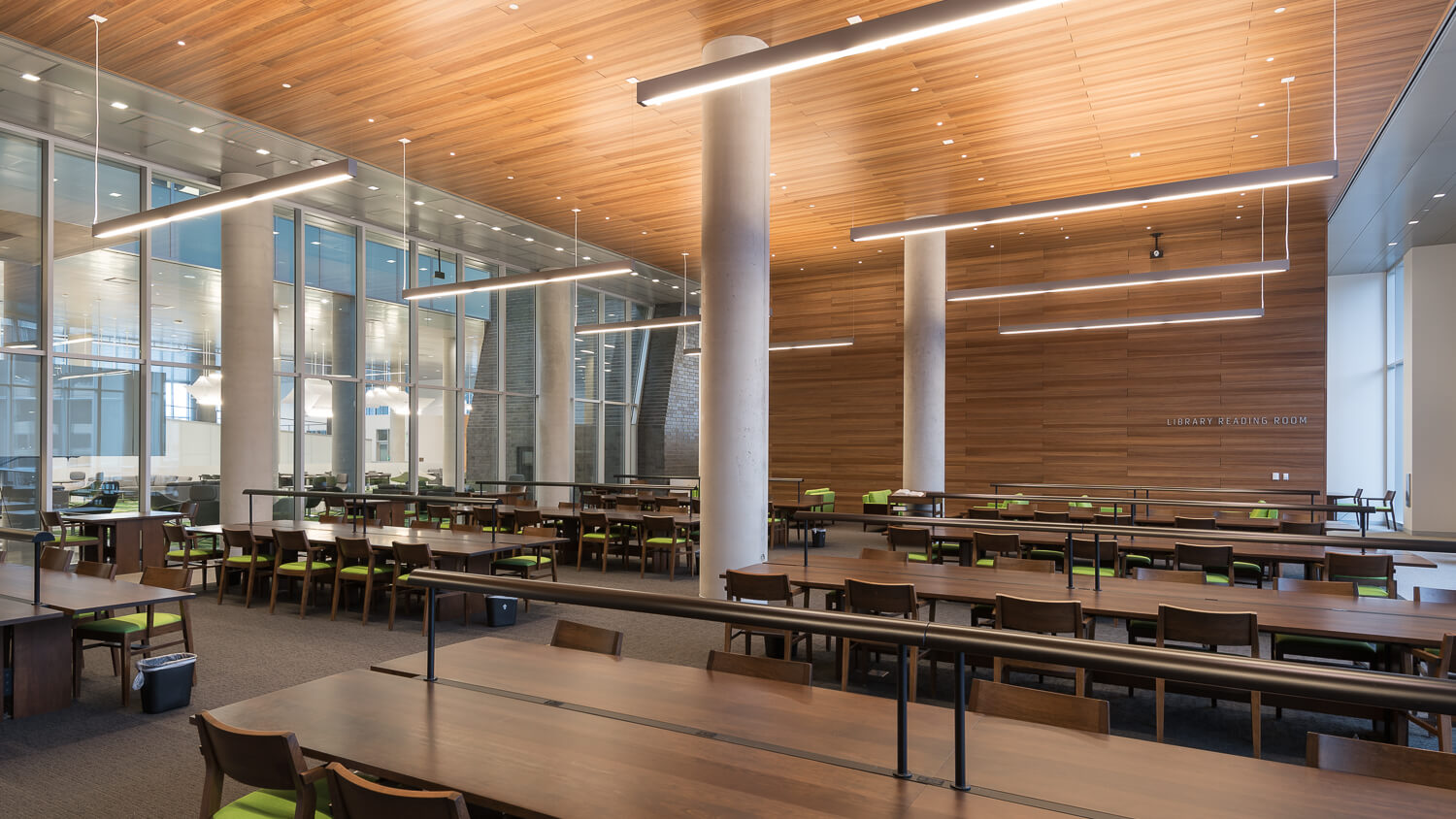
Colgate University embarked on a $57.5 million expansion/renovation project. The endeavor combined full renovation of the existing 101,000 square foot Case Library building with a 51,000 square foot addition for its new Geyer Center for Information Technology, taking it from a four story structure to five.
O’Connell’s extensive college and university experience positioned us as a top candidate for the Case Library project. Our competitive bidding sealed the deal. We were awarded a $4.4 million contract by the Gilbane Company for full electrical construction. Scope of work required upgrading the renovated library’s outdated electrical service and new electrical work for the Geyer Center as well as new multi-media production suite, high-tech work stations, meeting spaces, lounges, and cafe.
Over a one and a half year construction schedule, O’Connell installed new primary underground electrical structures, 2,500 amp main electric service, and automatic transfer 300 KW natural gas indoor standby generator systems to the building complex. We also furnished all architectural lighting, lighting control and life safety systems, building access control and management systems, all grounding systems and lightning protection, and site lighting.

To meet power requirements for the new 235,000 square foot Life Sciences Building, as well as other projects in planning, the electrical distribution system for Syracuse University’s entire north campus needed to be upgraded.
O’Connell was awarded the $2.7 million contract to upgrade the north campus substation. This work involved installation of two new 10MVA transformers, construction of a new 35/15KV switchgear building, and new duct bank system. Modifications and upgrades were made to the existing unit substations. Several medium voltage cables and breakers that had failed over recent years were also replaced. In total, 5000 linear feet of new power and control duct banks were installed that included over 15,000 feet of conduit, 35,000 feet of 15KV cable, and 5000 feet of multi-conductor control cables. Project challenges were compounded by the steep wooded parcel where substation construction took place as well as the high student, faculty, and vehicle traffic volume that accompanied the duct bank construction. All surfaces were restored within a twelve week time frame.
O’Connell also completed a $9 million contract for major electrical construction of the 6 story, 235,000 square foot Syracuse University Life Sciences Building, the largest project undertaken in the university’s history.

The Cornell Combined Heat and Power Project (CCHPP) is a significant capital improvement to Cornell's central heating plant. Currently, Cornell University purchases most of the electricity it uses, and generates heat principally through the combustion of coal. The CCHPP project will introduce two generator trains consisting of Combustion Turbines (CTs) with Heat Recovery Steam Generators (HRSGs), principally powered from natural gas, to allow the campus to use a combined heat and power system to generate electricity and heat the campus. The inclusion of these systems will fundamentally change the way the University operates its heat and power utilities.
As part of this overall project, O’Connell Electric is serving as the General Contractor for the expansion and rehabilitation of the existing Cornell University substation. The Cornell University, Maple Avenue Substation Renewal Project is being constructed to accommodate new distributed generation via the Cornell Combined Heat and Power Project and to increase the Substation’s capacity for future load growth. This project is converting the existing substation to a three transformer station with a three-bus 13.2KV Ring Configuration utilizing medium voltage vacuum switchgear. Each transformer will be rated 20/26.6/33.3MVA 115KV/13KV.

Syracuse City Schools initiated a major consolidation program aimed at increasing efficiency and reducing costs across the district’s 45 schools. A key component of this effort included a $6 million contract to consolidate all school communications systems.
Under a $2.5 million contract, O’Connell installed and tested the voice and data telecommunications systems at 38 out of 45 Syracuse City schools, providing all project management, labor and materials. A pivotal piece of the project relied on O’Connell’s ability to staff and tool for the extensive structured cabling and raceway requirements, complete with wire mold and cable tray systems. Our fiber optic fusion splicing capabilities afforded another component of the project’s success. All told, the Syracuse City Schools project showcased O’Connell’s proficiency in tooling, equipping and resourcing a multiple site communications project on schedule and within budget.

With a student enrollment of nearly 29,000, the University at Buffalo (UB) is the largest public university in the Northeastern United States. As a member of the National Collegiate Athletic Association (NCAA), the school hosts home football and soccer games as well as track and field events at UB Stadium. Current televising of NCAA football games in High Definition (HD) required greater illumination of the playing field than the original stadium lights could deliver necessitating the rental of additional lights. Concerned about energy efficiency and operating costs of the existing lighting system, UB approved a permanent lighting upgrade for the stadium. In addition to facilitating HD television broadcasts the new eco-friendly stadium lighting system is reported to be saving the university $70,000 in energy costs annually. This aligns with the school’s energy conservation and green building goals outlined under the UB Green initiative.
Under an $860,000 contract from the University at Buffalo, in conjunction with the New York Power Authority, O’Connell was hired as prime contractor to upgrade the lighting systems at UB Stadium. Project scope involved the construction of eight new stadium light structures, demolition of the four existing structures, trenching for new conduit, cable, and wire, and energizing the new lights by tying into the stadium’s existing power supply.
O’Connell subcontracted the eight new concrete foundations, each over twenty-feet deep, as well as the crane work for both setting and demolishing the light towers. The new light structures were installed, aligned, and powered-up in pairs prior to their single-tower counterparts being decommissioned and dismantled. The four existing light structures were cut apart and lowered to the ground where O’Connell technicians systematically disassembled each of the 108 light fixtures for proper recycling and disposal of their electronics, ballasts, lamps, and glass. The eight new light towers carried only 35 light fixtures each (totaling 152 fewer overall than the four original towers) while providing greater illumination at much higher energy efficiency ratings.
O’Connell executed its project work around active field and stadium events, coordinating the clearing of office personnel and athletes from the UB Stadium buildings and field during scheduled pole lifts. O’Connell and its subcontractors met all project obligations with zero reported safety incidents, beating our deadline to have the new lights up and operational for the first televised NCAA college football game of the season.